

Have you ever been on a city tour? Chances are you have. But have you ever tried a feminist city tour?
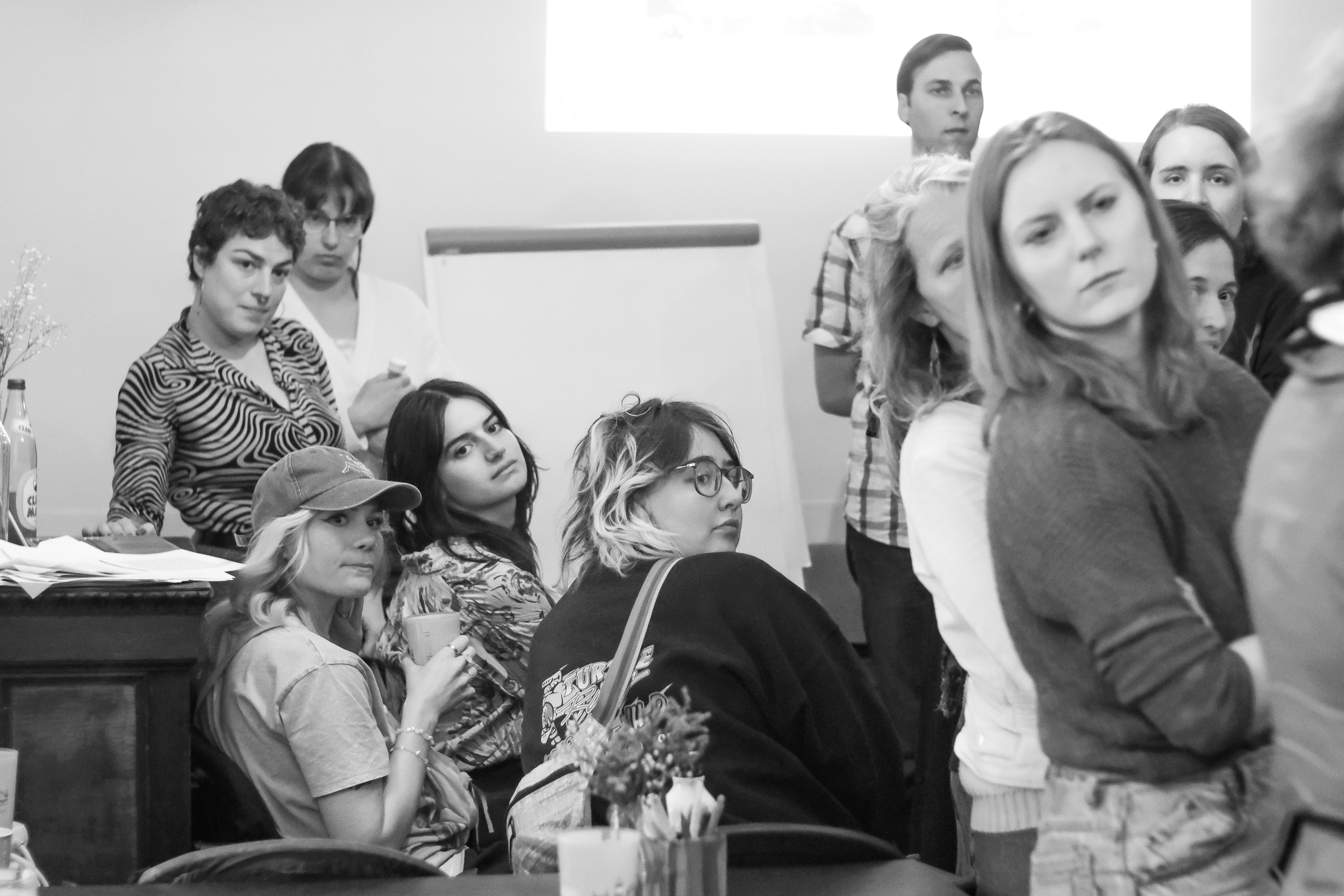
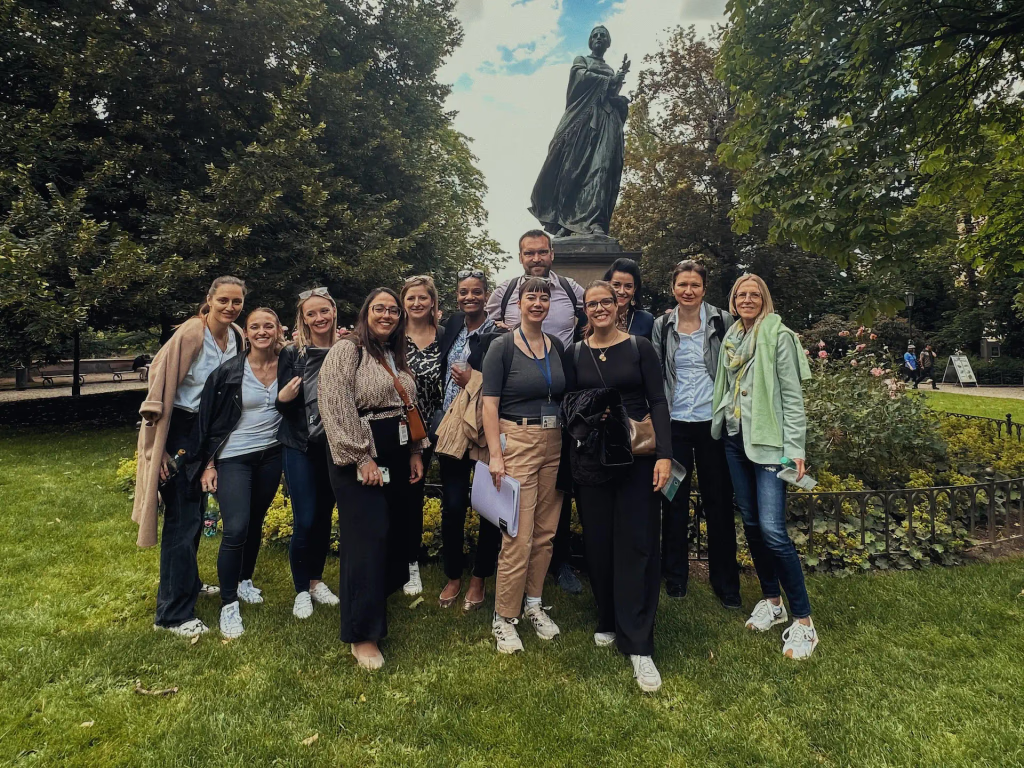
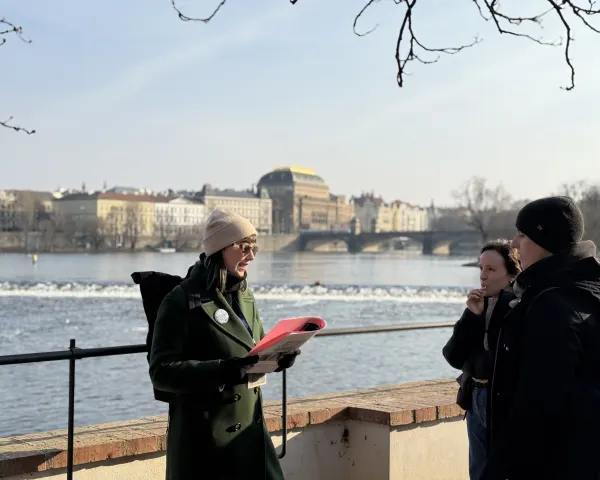
On a chilly February afternoon, a group of fifteen gathers in Prague’s historic centre, right below the Charles Bridge, for a special Valentine’s Day walk. Don’t expect just romance, though. This tour explores how love, memory, and public space intersect. Instead of legends about kings or lists of architects, the next hour and a half promises stories of resistance and emancipation. Leading the way is Averil Huck, a French gender expert and guide, who has been living in the Czech Republic for several years.
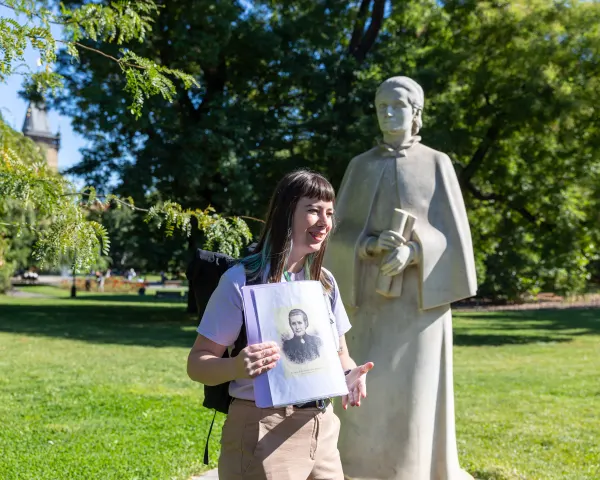
Averil studied philosophy and gender studies in France. An Erasmus exchange sparked her interest in international perspectives, and an internship eventually brought her to Prague. What was meant to be a four-month placement at the Czech Academy of Sciences turned into a three-year employment. There, she first encountered Czech women’s history.
“As a Western European, I had never heard of Karolina Světlá, Františka Plamínková, or Milada Horáková,” she recalls.
Realizing these stories were largely invisible, she decided to create her own project – and that’s how Prague Feminist Tours was born. By bringing these narratives into the public space, especially in English, Averil challenges a version of history that too often sidelines women's political, cultural, or intellectual contributions, making the stories more accessible to international audiences.
Exploring Prague Through a Feminist Lens
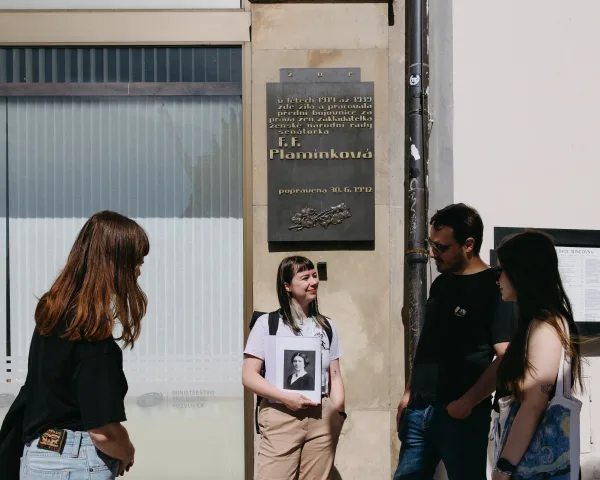
Back on Prague’s streets, our first stop at the Lovers Bridge (where couples still lock their love with padlocks) introduces Františka Plamínková, a teacher, one of Czechoslovakia’s first female senators, and a women’s rights advocate. She fought for the removal of the celibacy rule for women teachers and civil servants, challenged societal expectations, and championed women’s freedom to pursue education, career, or family on their own terms. Choosing the professional path over convention, she broke off her engagement. “Plamínková was later arrested by the Gestapo and executed by the Nazis. Today, she stands as a symbol of courage and political agency,” Averil explains.
Moving through the Malá Strana district, we continue onto Kampa Island across from the National Theatre. This Neo-Renaissance building brings up the name of another woman, Olga Scheinpflugová Čapková. She was a poet, actress, and the wife of the writer Karel Čapek. Despite being the partner of a famous author, Olga carved her own path, maintaining independence and an artistic career. Although her husband is officially credited as the author of the play Matka (Mother), she is believed to be the true creative mind behind it. Later, she faced Nazi persecution and died on stage at the National Theatre from a heart attack, still performing.
Our guide then tells us the story of tennis player Martina Navrátilová, who came out as a lesbian in 1981, at a time when queer people were heavily marginalized. After emigrating, she was erased from the Czechoslovak media.
“Love who you are and fight for the right to exist freely,” Averil summarizes, as we stand in front of the Tyrš House, home of the Czech sports organisation called Sokol.
A particularly powerful moment of the tour occurs near the memorial of six bronze statues at the foot of Petřín Hill, symbolizing the victims of communism. Here, we remember Milada Horáková, lawyer, politician, and women’s rights activist, and the only woman sentenced to death in the Communist show trials of the 1950s. She represented herself in court and tried to lower her charges, but the outcome was predetermined. A few hours before her death, Horáková wrote letters to her loved ones. However, the communists did not deliver the letters to the family, and they only reached her daughter in 1989.
Put Her Name on It
The tour repeatedly returns to the idea that public space is political. Street names, statues, memorial plaques – none of them are neutral. They shape collective memory and signal who society values. In Prague, according to server iRozhlas.cz, only around 5% of streets named after people bear women’s names. Across Europe, the Mapping Diversity project shows that even the best-performing cities, such as Stockholm (19,5%) or Madrid (18,7%), do not reach gender parity. The researchers found that over 90% of European streets named after individuals honor white men.
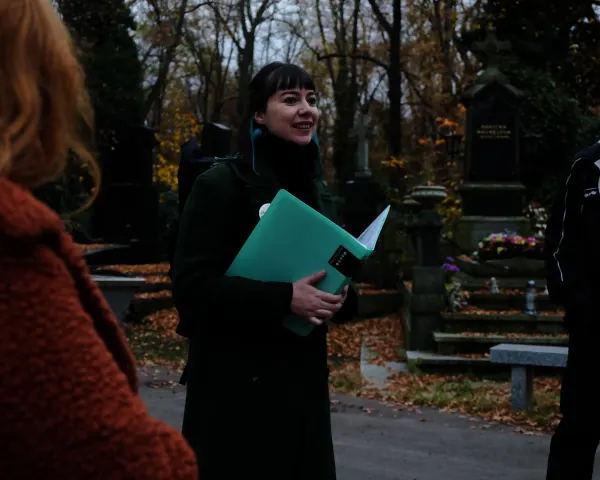
The situation in Eastern Europe can be especially illustrative. In countries such as Croatia or Romania, researchers from the previously mentioned project have found that in many cities, around 5% of streets are named after women. This chronic underrepresentation highlights how deeply embedded gender biases are in the public space. “It is symbolic, but it's still important to fight the patriarchal narrative that men achieved it all. It's just historically untrue,” Averil points out.
Celebrated, But at What Cost?
Perhaps the most provocative stop is the memorial of Karel Hynek Mácha, author of the poem Máj (May), often celebrated as one of the great Czech romantic poets. His private diaries, however, reveal jealousy, control, and non-consensual behaviour towards his fiancée.
“It’s undeniable that Mácha’s work shaped Czech literature. But should we continue celebrating him uncritically, without acknowledging his deeply troubling behaviour? Many schools still teach his poetry without discussing the reality of his private life, sparking an important conversation about separating art from the artist.”
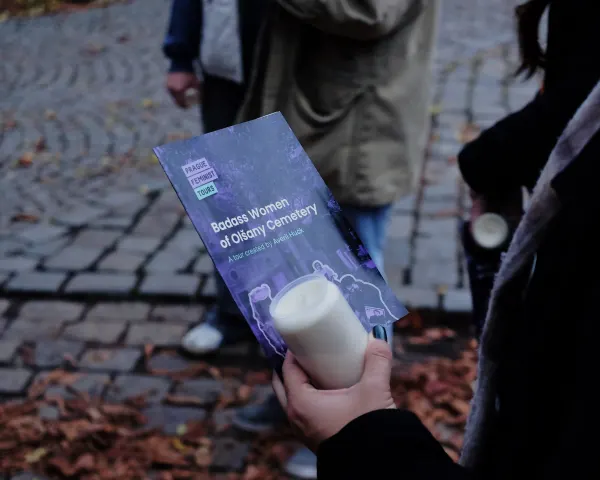
Averil leaves this question lingering in the air as we walk past his bronze sculpture in the Petřín gardens. It's a striking reminder that male public figures have long been remembered for their cultural or political contributions, even when they have abused or marginalized the women in their lives – a pattern familiar not just in the Czech Republic.
Yet the tour does not end with disillusionment. Prague Castle, the residence of the Czech presidents, rises before us as our guide recalls the partnership of Charlotte Garrigue Masaryk and Tomáš Garrigue Masaryk, the first president of Czechoslovakia. Charlotte’s husband adopted her surname, and their marriage became a symbol of equality and shared commitment to Czechoslovakia’s independence.
As we finish the walk, Prague looks different. The statues are no longer just decoration. The street names carry weight. Czech women’s history is rarely taught in depth in schools, and when it is, it’s frequently reduced to footnotes or framed through their relationships to men. Public spaces reflect this imbalance.
“Memory politics has been a fierce battlefield in the countries of the former Eastern Bloc during state socialism and after, and the Czech Republic is no exception. The stages of the struggle over national memory are many: politics, media, culture, and historiography,” states Czech gender studies expert Libora Oates-Indruchová in her paper.
Averil’s tours, therefore, do not simply offer an authentic sightseeing experience – they intervene in the politics of memory by translating academic research into accessible storytelling. She makes feminist history visible and shareable.
For many participants, this matters deeply. “Even though I’m interested in feminist history, I hadn’t noticed most of these things before,” says Karolína Žánová, who has already joined several of the walks. For others, the tours are about connection and shared experience. “It’s our sister bonding time, and it’s amazing that something like this exists as an alternative to traditional tours,” adds another attendee, Kateřina Šubrtová. Some participants mention curiosity or simply a desire to see Prague in a different light. What becomes clear over the course of the walk is that the tour is not only about revisiting the past. It builds a present-day community of like-minded people and lifts the veil from stories that are often romanticised.